

Now that I am no longer a professional academic or on the quest to become a professional academic, I have felt adrift, with a ton of pent-up mental energy that’s had nowhere to go. So I have been trying to isolate the things I love best about academia. If I could identify the elements that brought me the most joy, maybe I could find an outlet for all of that energy. What did I enjoy about the “act” of being an academic (academicking?) besides traveling to gorgeous destinations to study things old and spending 90% of my time in a library surrounded by books?

Ultimately, it’s hard to boil it down to the basics, but I think I finally figured it out: what I miss the most is immersing myself in knowledge about a *noun*. Analyzing the details of a *noun*, its history; thinking about media and how the choices people/artists/creators made can tell us about any number of things about whatever it is they’ve created. How have people interacted with the *noun* in the past and what does that mean for the present? Besides just thinking about *things,* I love thinking about things with other people, and, also, thinking about how people think, and why we think what we think.
TLDR: my favorite thing to explore is this: what can we learn about humanity by considering the things people create? Why and how do we love things we love?
Though my quest to capture the essence of my past-academic self has been ongoing since finishing my PhD in 2019, I made unexpected progress this year in narrowing it down. In 2023, I started thinking about movies differently. In the spring, my brother-in-law was so hyped for Christopher Nolan’s latest film, Oppenheimer, and I didn’t really get it. Sure, I had heard of his love of Nolan as a filmmaker before, but I didn’t understand why. I also, in general, have a longstanding methodological beef with privileging a creator over the creation, putting too much emphasis on the artist as genius, which made me resistant to getting too excited about any single director or creator.1 More relevantly, I didn’t understand enjoying watching films with a critical eye like he and my SFAM (sister from another mister) do. I didn’t understand why Nolan’s use of IMAX photography was notable. I didn’t get what made the *films* special. And, I also, admittedly, was resistant to anything that could be labeled as uppercase Film, largely due to an intense focus on French film in my undergrad degree. (Let’s be real, French Film is overall an acquired taste that I have not acquired, though I have been well exposed.) However, he was so passionate about his love for these films, I wanted to understand. After all, what is better than listening to the people you care about care about something?

Thus, I asked him to put together a “Nolan 101” experience, so I could try to understand his love of Christopher Nolan’s movies. Unsurprisingly, he obliged. He put together a course of study and over the course of several months, our friend group watched seven Nolan films in the following order: (Night 1) Memento, The Prestige, (Night 2) Inception, (Night 3) Batman Begins, The Dark Knight, (Night 4) The Dark Knight Rises, and (Night 5) Oppenheimer (and Barbie).2 Through this exercise, I not only came to understand his love of Nolan’s approach to filmmaking but developed my own appreciation for the films. While I’m simplifying, our mutual appreciation is threefold: (1) how Nolan structures and plots the stories he tells and (2) how Nolan uses the art of film to tell the story, and (3) the effort he puts into pushing the art and science of film to the next level.
For what it’s worth, I’m a film convert.
But that’s not the point.
The point: This whole exercise got me thinking about movies in the same way I’ve always enjoyed thinking about other media, like musicals, books, sculpture, painting, and architecture. It turns out that you don’t have to enjoy French films to enjoy thinking about filmmaking. I loved watching Nolan’s films with an eye to aesthetics, style, storytelling, and historical/visual/social context. I am permanently and irrevocably ruined. Utterly changed because now I’ve been watching everything–including things that I’ve long loved and watched countless times!–with my nerd brain activated.

And it’s fun, dammit.
That got me thinking that perhaps this kind of activity could help me flex my brain muscles again but in a new and fun way, in a way I’ve long missed. Could I harness all that pent up academic brain juice and funnel it into something fun and thought-provoking without it ‘advancing the field’? What if I directed all of that thinking towards that silly stuff that I like rather than just concentrating on making something ‘academically rigorous?’
A new exercise began to take shape in my mind, a series where I “overthink” things that I love and enjoy. Sometimes it might be a deep dive into a single thing. Sometimes, it might be a comparison between a series of things. Some others may be explorations of places I’ve been and its history. At times, the connection might be quite obvious (as the first in this series will undoubtedly be to those who know me). Other times, the connection might be entirely off the wall– the result of a weird wandering of my (probably) ADHD brain.
In this series, I’ll present reactions, responses, questions, research, and opinions other than my own, and of course my own opinions. I’ll always try to be honest, accurate, and fair. I’m sure I’ll get things wrong, but I’m always willing to learn and to admit that I was wrong. Some of the topics may interest you, others may not. The assignment I give myself may change, but for now, it’s to think about things critically and smartly. To put forth mini-essays that are interesting and edifying, even if it doesn’t represent any great stride for any academic discipline.

Will these essays have a thesis? Probably not any kind that would stand up under peer-reviewed scrutiny. The thesis will be whatever I find interesting–whatever I say it is. One of the things I liked less about academia was always having to have a point, a culmination that ends because a question has been answered, an argument made, nuance achieved. A finality, an end. The end, however, isn’t the point of everything we do–the axiom goes that life is the journey. What I envision with this series is instead a wandering, meandering path. Why do we have to know where we’re going before we start out? Isn’t it all about the journey? Why do we have to know where we’re going before we get there? Why do I need a thesis?3
I don’t claim to have any great insights to share. I am not a scholar of popular culture, and while I might have some particular knowledge when considering certain topics, such as art history, my thoughts are no more important than anyone else’s. I will always cite words and ideas not my own. I try to base my thoughts on facts, research, and, to some degree, my own experience.
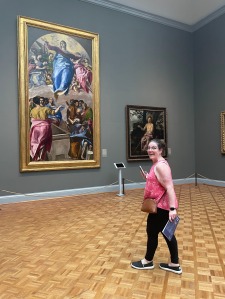
If your thoughts are based on facts, research, and your own experience, you’re the kind of person I love talking to. 🙂 Feel free to respond! I hope to elicit conversation with anyone who finds what I put out there interesting or thought-provoking. Another key thing that I miss about academia was the sharing of ideas, talking about the things I liked with others who also liked those things, and listening to their thoughts on the matter. In fact, I can’t think of a better way to spend an afternoon other than talking about things that I love and the things that my people love with others who also love those things.
So who wants to go with me on a pointless journey to the deepest, most randomest parts of my brain? Here we go!
Stay tuned for the first in my Overthinking series, Adapting Jane Austen’s Emma.
Footnotes
- This could be a whole other series on why I think we focus too much on individuals as creators. I’ll save it for another day, but I have reasons. ↩︎
- Truthfully, Barbenheimer stood outside the official Nolan 101, but we couldn’t *not* watch it as a part of this exercise in 2023. ↩︎
- In all honesty, my posts will probably have *a* thesis, but it won’t be one that’s super concerned with being innovative or making a “contribution” to the field. ↩︎
 Chronicles of a Homebody Adventurer